

When the Truck Itself Is the Danger: Underride Guard Failures in Kentucky Truck Crashes
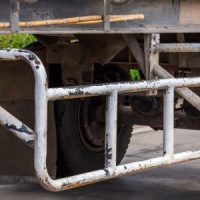
Most people picture a truck accident as a collision between two vehicles of similar size, but that is not how the deadliest crashes with semi-trucks usually happen. When a car strikes the rear or side of a trailer and slides beneath it, the results are often catastrophic, and the trailer’s own equipment may be to blame. Our experienced Madisonville truck accident lawyers explain how underride guard failures happen and what victims and families need to know.
What Is an Underride Crash
An underride crash happens when a car’s front end slides beneath a trailer bed instead of striking a solid bumper. Because the trailer sits higher than a standard bumper, the impact often bypasses the car’s crumple zones and airbags entirely, striking the windshield and roofline directly. These crashes are frequently fatal even at moderate speeds.
Rear guards, sometimes called ICC bars, exist to stop a car from sliding underneath a trailer during a rear-impact collision. Side guards serve a similar purpose along the trailer’s length. When these guards are missing, poorly maintained, or not strong enough to withstand the force of impact, drivers and passengers lose a critical layer of protection.
Common Reasons Underride Guards Fail
Underride guard failures are not always the result of one obvious defect. Common factors include:
- Rust, corrosion, or structural damage from a prior minor collision that went unrepaired.
- Guards that were improperly welded or mounted during manufacturing or repair.
- Older trailers manufactured before current federal standards took effect and never retrofitted.
- Missing guards that were knocked off in a prior incident and never replaced.
- Side underride guards, which many trailers still lack entirely, since federal rules for side protection remain far less developed than rules for rear guards.
Who Can Be Held Responsible
Liability in an underride crash can extend well beyond the truck driver. The trucking company may be responsible if it failed to inspect or maintain the trailer’s guards. The trailer manufacturer may share liability if the guard was defectively designed or built. A repair contractor could also be accountable if prior work left the guard weakened. Identifying every liable party requires investigating the trailer’s maintenance history and inspection records.
The National Highway Traffic Safety Administration updated its federal safety standards for rear impact guards in 2022, requiring trailers to withstand rear underride crashes at higher speeds than the old standard allowed. That change reflects how serious this danger is, yet it applies only to newly manufactured trailers, meaning many older trailers on the road were never required to meet it.
Seek medical care immediately, even if injuries seem minor, since head and spinal trauma is not always obvious right away. Preserve the vehicle if possible, and avoid authorizing repairs before it has been inspected. Request that the trucking company preserve the trailer, its maintenance logs, and any inspection reports before that evidence can be lost.
Speak With Our Experienced Madisonville Truck Accident Lawyers
Underride crashes are among the most severe truck accidents on the road, and proving what went wrong with the trailer’s safety equipment takes real investigative work. At Whitfield Crosby & Flynn, we dig into maintenance records, inspection history, and manufacturing specifications to hold every responsible party accountable. If you or someone you love was hurt in a crash involving a semi-truck or trailer, contact our Madisonville truck accident lawyers for a free consultation.
We proudly serve clients in Madisonville, Kentucky; Chattanooga, Tennessee; Indianapolis, Indiana; and Marion, Illinois.
